
Hawaii real estate SEO grounded in licensed people and current market facts.
Licensed identity, dated reports, and what moves the range
A Wailuku-based search program for Hawaii agents, teams and brokerages—joining a controlled listing system with accurate local entities, maintainable reports and a clearly scoped engagement.


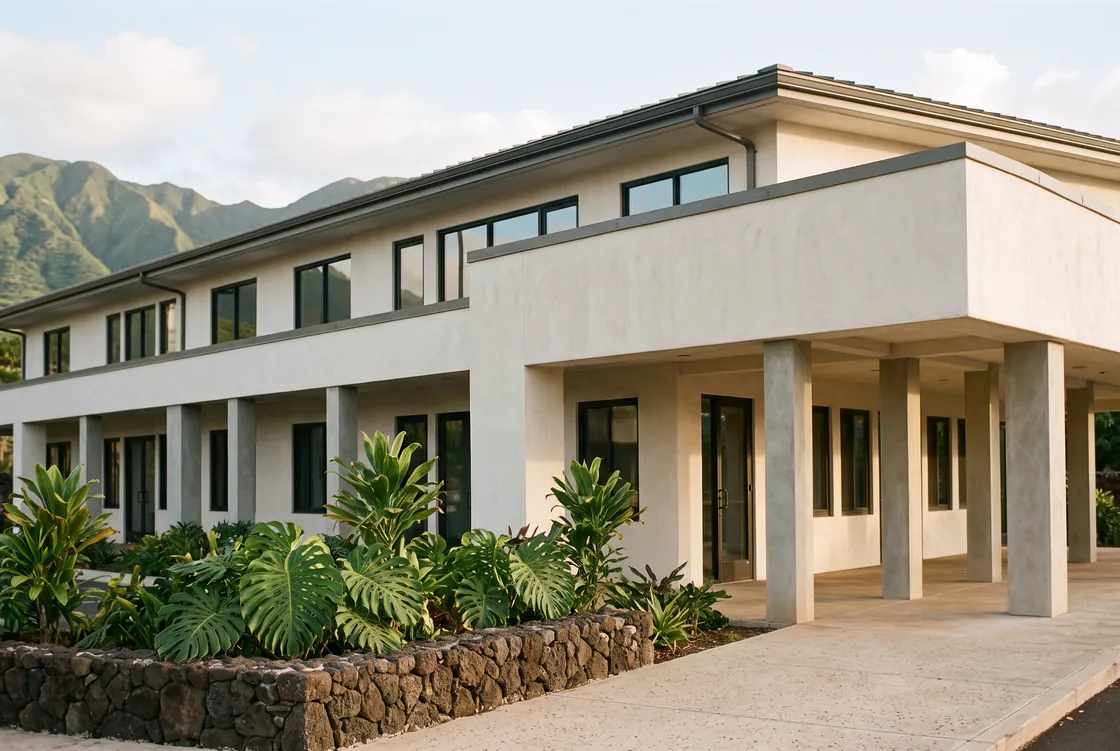
What the Hawaii engagement actually covers.
From one Wailuku base, with the rest of Hawaii a service area, Digital Reach structures the entity record, the owned local layer, the feed-governed listing set and reports. Work is month-to-month. Some packages carry a setup fee. License, feed and fair-housing questions stay with the client’s authorities.
The complete technical system lives on the national page: real estate SEO for agents and brokerages.
The Hawaii layer is built from records, not atmosphere.
What differs is concrete: the state record behind a name, sources that stop at a county line, a purchase leg run remotely, and data that ages.
Weighting follows the client’s own Search Console, profile, call and inquiry records; cross-industry Hawaii SEO context stays put.
| The question | What the page carries | Confirmed by | Where it stops |
|---|---|---|---|
| Who stands behind it | Licensed name, status | Broker-in-charge | Not a rating |
| If a figure applies | Period, measure | Data owner | Not a forecast |
| Where to go | Address, hours | Operations owner | No outcome |
Three printed origins, and nothing inferred behind them.
Table E-12 of DBEDT’s Quarterly Statistical and Economic Report, 2025 Q1 counts statewide Hawaii home sales by origin of buyer in calendar 2024 — 13,390 local buyers, 4,110 mainlanders, 507 foreign buyers, each a completed purchase and not a person, a search or a client — from Title Guaranty of Hawaii, Inc. figures based on Bureau of Conveyances data, calculations by DBEDT. A reader’s international is DBEDT’s foreign.
| DBEDT’s label | What the row says | What changes | Never inferred |
|---|---|---|---|
| Local buyers | A calendar-year tally | Resident questions, a local route | Residency, means |
| Mainlanders | Purchases from the mainland | Remote steps run | Motive |
| Foreign buyers | DBEDT’s own label | Document, time-zone routes | Nationality |
The contact route and remote sequence are documented only where the firm actually runs one.
A state record fixes the words beside a name.
DCCA’s Real Estate Branch stacks its salesperson and broker paths — a broker already holds a current salesperson license and the experience — grants no reciprocity and asks no residency, and licenses brokerages separately. The licensing owner checks the public license search; HAR §16-99-11 and its rules index fix what prints.
| What a page claims | Confirmed against | If unconfirmed |
|---|---|---|
| Brokerage legal name | Broker-in-charge | Hold it |
| An individual’s name | Broker-in-charge, DCCA record | Return unpublished |
| Broker or salesperson status | Licensing owner | Drop the line |
| Leasehold or lodging | Broker and counsel | Do not publish |
The advertising rule fixes whose licensed name, which brokerage and which status sit beside a claim; it settles nothing about whether the claim is true. It adds, for a current member of the Hawaii Association of Realtors, “Realtor (R) or Realtor-Associate (RA),” a membership mark, never a licensee synonym. A license is a record, not a rating.
The advertising rule fixes whose licensed name, which brokerage and which status sit beside a claim; it settles nothing about whether the claim is true.
A staffed office earns a page; a service area earns a setting.
A page is earned where people sit and work — address, hours, services.
Four rules decide what gets built:
- A license, an MLS area, a service-area setting or an island served earns no page.
- Under §16-99-11(f), an unregistered business address in advertising carries the principal or branch street address, identified as such.
- Google’s representation and service-area rules decide profiles.
- Google rules a virtual office out and makes a shared desk turn on signage, reception and staffing; the client settles it and owns the profile, Digital Reach manages.
The agency’s own base is a Wailuku office; no island earns a look-alike page.
County, island and MLS area are three different maps.
The Census 2024 Hawaii county file names five counties; county, island, MLS area, service area and office differ. Update points: Hawaii REALTORS Housing Trends, a dated Honolulu report, the county portal.
| Source record | What it supports | Never proves |
|---|---|---|
| The county file | A named geography | A service area |
| Island tabs | A dated module | A town finding |
| A dated Oahu report | One period, one island | A statewide claim |
| The county portal | County context | Coverage within a county |
Each figure carries period, measure, source, retrieved date and a named owner, leaving the index when either goes. The page carries no framing built on schools, safety, or who lives nearby.
Five steps from permission to published evidence.
The sequence is the deliverable, not quantities.
Confirm the permission
The MLS or IDX contract, not a general rule, settles display, attribution, disclaimer and retention; broker and vendor answer.
Classify the URL
Duplicates are ordinary: Google clusters and picks a canonical; redirects and canonicals signal strongly, sitemaps weakly; noindex needs a crawlable page.
Reconcile the record
One approved entity crosses site, profiles and directories; markup restates what the page already shows, and nothing more.
Govern what publishes
A sold or expired property follows a written archive policy and status code, never a bulk redirect.
Report what changed
What shipped, what the index did, what people did.
The owned layer is what no feed supplies: people, process, observation; technical depth sits nationally.
The range follows scope, and nothing about size.
Market crowding, real places and people in scope, site and URL-inventory condition, and corrections owed move the number. Size is no input; the published formula and its inputs serve everyone.
The tool’s four named controls:
- Business type — real estate, the formula’s 1.35× setting.
- Primary island — which island market the estimate is for.
- Competition tier — low, medium or high.
- Do you already get organic traffic? — a starting-point read, nothing more.
What comes back: a monthly range and scope label, never a quote, forecast, audit or setup-fee decision. Engagements run month-to-month. Some packages carry a setup fee. The general SEO engagement model holds the terms.
Estimate the Hawaii real estate engagement.
Your business type, island, and competition tier set a realistic monthly investment range here. The math behind it is the same published Digital Reach formula, so what comes back is a planning range rather than a quote. Real estate enters that formula at 1.35× on the business-type input. Engagements stay month-to-month. Some packages carry a setup fee.
Range, not a quote — your actual scope determines final price. Formula and inputs are published on our pricing methodology.
One lead, one base, and two counts kept apart.
Founded in 2016 and senior-led since by Shane Perry, Founder + Lead SEO Strategist — who runs the work sits inside the accounts. One base: 25 Kamaha’o Street, Wailuku, HI 96793; the rest is service area.
The current book is 10+ active retainers. Separately measured, over 100 businesses across Hawaii over 10-plus years spans a decade belonging to no vertical or island. No Hawaii real-estate client is named. The arrangement is month-to-month. Some packages carry a setup fee.
Frequently Asked Questions.
Don’t see your question? Call (808) 758-5058.
What makes real estate SEO in Hawaii different?
Four things: the state record behind a name, the geography each report covers, the named owner a dated module needs, and the buyer origins DBEDT’s table separates — all firm- and source-specific.
How should resident, mainland, and international buyer paths be handled?
Three documented processes on DBEDT’s labels — local, mainlander, foreign. The 2024 rows are completed purchases, not people or searches; publish only the process the firm runs.
Which Hawaii real estate license facts can a website publish?
Only fields the broker-in-charge confirms against the DCCA record, as HAR §16-99-11 requires: brokerage legal or trade name and, for a named individual, licensed name, employing brokerage and status. Interpretation routes to counsel.
How should Hawaii island and county market reports be maintained?
Separately: county record, island, MLS area, service area and office differ. A module publishes only while a named owner keeps its figures dated and sourced, and leaves the index otherwise.
What does the Hawaii SEO calculator estimate?
Monthly engagement pricing from the published formula, real estate at 1.35×. Its controls: business type, primary island, competition tier and whether organic traffic already exists. Not a quote. The engagement stays month-to-month. Some packages carry a setup fee.
Related resources + tools.
Sources
- Hawaii DBEDT — Quarterly Statistical and Economic Report 2025 Q1, Table E-12 and the county data portal (https://dbedt.hawaii.gov/economic/county-data-portal/), read 2026-09-15: the table counts calendar-2024 statewide home sales by origin of buyer, from Title Guaranty of Hawaii, Inc. figures based on Bureau of Conveyances records, calculations by DBEDT. Rows are completed purchases, never unique people or searches.
- Hawaii market update points — Hawaii REALTORS Housing Trends, the Honolulu board’s dated July 2026 report (https://www.hicentral.com/mpr/mpr-2026-07.php) and the Census 2024 Hawaii county file (https://tigerweb.geo.census.gov/tigerwebmain/Files/acs24/tigerweb_acs24_county_2024_bas24_hi.html), read 2026-09-15: each carries its own period and geography for a dated module. The canonical host is cited for the first, where research recorded a mobile host.
- Hawaii DCCA Real Estate Branch — branch home, general licensing information (https://cca.hawaii.gov/reb/real_ed/general-licensing-information/), branch FAQ (https://cca.hawaii.gov/reb/faqs-re_faqs/), read 2026-09-15: stacked salesperson and broker paths, no reciprocity, no residency requirement, brokerage entities licensed in their own right. The public license search (https://mypvl.dcca.hawaii.gov/public-license-search/) is DCCA’s own “Verify a Professional” link and returns a bot block; the licensing owner opens it in a browser before any personal fact publishes.
- Hawaii Administrative Rules, Title 16 Chapter 99 — subchapter PDF (https://cca.hawaii.gov/reb/files/2017/04/99-C.pdf, now served from https://cca.hawaii.gov/wp-content/uploads/2026/02/99-C.pdf) and rules index, read 2026-09-15: §16-99-11 sets the printed form of advertising, including brokerage name, licensee-status disclosure, leasehold identification and the unregistered-place-of-business address rule; §§16-99-147 and 147.1 sit behind transient-lodging confirmations. Broker and counsel read the current text first.
- Google Search — canonicalization, duplicate consolidation (https://developers.google.com/search/docs/crawling-indexing/consolidate-duplicate-urls), faceted navigation (https://developers.google.com/crawling/docs/faceted-navigation), robots meta tag (https://developers.google.com/search/docs/crawling-indexing/robots-meta-tag), HTTP status codes (https://developers.google.com/crawling/docs/troubleshooting/http-status-codes), search gallery (https://developers.google.com/search/docs/appearance/structured-data/search-gallery) and structured-data policies (https://developers.google.com/search/docs/appearance/structured-data/sd-policies), read 2026-09-15: duplicates are ordinary, a canonical is selected, crawling precedes any noindex, and the supported-feature list holds no real-estate-listing enhancement.
- Google Business Profile — representation, categories (https://support.google.com/business/answer/3039617?hl=en), service areas (https://support.google.com/business/answer/9157481?hl=en), contributed-content policy (https://support.google.com/contributionpolicy/answer/7400114?hl=en) and review guidance (https://support.google.com/business/answer/3474122?hl=en), read 2026-09-15: these govern eligible operation, real-world identity, category and service-area limits, and genuine reviews without incentive, gating or prescribed wording. The profile owner settles every fact with Google; Digital Reach issues no eligibility decision.
- Fair-housing and association rules — HUD rights and obligations and Fair Housing Act overview (https://www.hud.gov/helping-americans/fair-housing-act-overview), the Hawaii Civil Rights Commission (https://labor.hawaii.gov/hcrc/) as the state referral route, and NAR’s 2026 Code (https://www.nar.realtor/about-nar/governing-documents/code-of-ethics/2026-code-of-ethics-standards-of-practice), governing documents (https://www.nar.realtor/about-nar/governing-documents/nar-constitution-bylaws) and 2025 MLS policy handbook (https://www.nar.realtor/sites/default/files/2025-05/PDF-HMLP-2025-Handbook-on-Multiple-Listing-Policy-2025-05-30.pdf), read 2026-09-15: advertising is covered, a membership mark identifies a member and not a licensee, local contracts control display.
One call settles fit before anything is scoped.
The first call is free: a Wailuku conversation, senior-led since 2016, about fit.
Work runs month-to-month, no position is promised, and the client’s authorities settle license, feed and fair-housing questions.